

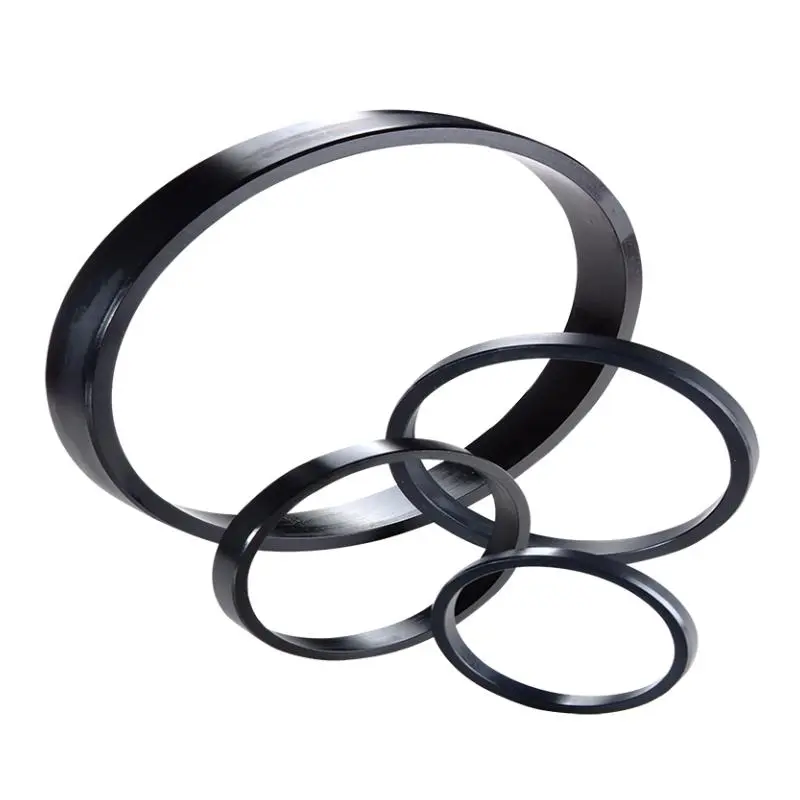
- Working temperature range -60°C to +260°C (continuous), short-term peak +310°C
- Radial clearance standards Approx. 50% of API 610 standard metallic clearances (e.g., typically 0.10-0.13mm for Φ≤50mm, 0.12-0.20mm for Φ50-150mm)
- Surface roughness Mating surface Ra ≤ 0.4μm, non-working surface Ra ≤ 1.6μm
- Dimensional tolerances Inner diameter ±0.015mm, outer diameter ±0.020mm, thickness ±0.030mm
- Hardness range Shore D 85-92 (pure PEEK), Shore D 92-98 (carbon fiber reinforced)
- Mechanical strength Compressive strength: ≥ 125MPa, flexural strength ≥ 170MPa
- Wear rate ≤ 0.02mm/1000h (clean water media), ≤ 0.08mm/1000h (sand-containing media <200mg/L)
- Friction & Expansion Friction coefficient: Dry 0.12-0.18, wet 0.08-0.12. Linear expansion: 4.7×10⁻⁵/K (pure PEEK)
- Tensile strength ≥ 95MPa (pure PEEK), ≥ 130MPa (reinforced type)
- Chemical resistance Resistant to dilute acids, alkalis, and organic solvents (not recommended for concentrated sulfuric/nitric acid)
- Applicable conditions Pressure capacity: ≤ 25MPa (static), ≤ 16MPa (dynamic). Speed: ≤ 4500rpm (standard clearance)
- Size specifications Inner diameter Φ20-Φ400mm, wall thickness 3-15mm, axial height 8-50mm (supports custom)
Application Fields
Chemical Process Pumps
Applied in API and ANSI pumps conveying corrosive media, replacing bronze and stainless steel wear rings. Avoids electrochemical corrosion. Service life in harsh chemical environments (e.g., concentrated alkaline) exceeds metal rings by 3 times, maintaining efficient operation for over 5000 hours.
Power Plant Boiler Feedwater
Used in high-temperature, high-pressure feedwater pumps (150-180°C, 8-15MPa). Maintains dimensional stability in hot water. Reduces clearance wear by 50% compared to bronze, lowering power consumption by 2-4% with no frequent replacement needed.
Seawater Desalination
Used in reverse osmosis high-pressure pumps. Completely resistant to chloride ion corrosion (35,000ppm chlorides), avoiding dezincification. Combined with ceramic or tungsten carbide shaft sleeves, the inspection cycle is extended to 18-24 months.
Oil Field & Sanitary Pumps
Oil Field: Resistant to sand (150-300mg/L) and H2S corrosion, lasting 8,000-12,000 hours.
Food/Pharma: Complies with FDA 21 CFR 177.2415 and EU 10/2011. Withstands 121°C steam sterilization, meeting GMP requirements.
Common Failure Causes and Remedial Measures
Increased Clearance (Efficiency Decline)
- Causes:
- Wear exceeds 200% of initial clearance;
- hard particles (hardness > HV 1000) concentration > 500mg/L;
- dry friction > 30s during startup;
- vibration runout > 0.1mm.
- Remedies:
- Replace when exceeding 150% of API 610 value;
- install cyclone desander (≤ 50μm);
- fill pump with liquid before startup;
- check rotor balance and correct coupling alignment.
Rubbing and Seizure
- Causes:
- Installation clearance too small (< 80% recommended);
- thermal expansion miscalculation;
- lodged foreign objects;
- excessive axial movement (> 2mm);
- concentricity > 0.15mm.
- Remedies:
- Reset clearance per API 610 (+0.05-0.15mm for high temp);
- thoroughly clean pump;
- limit axial play within ±0.5mm;
- correct coaxiality ≤ 0.08mm.
Cracking, Breakage & Wear
- Cracking Causes:
- Press-fit interference > 0.15mm;
- thermal shock > 100°C/min;
- insufficient wall thickness (< 3mm) for pressure.
- Excessive Wear Causes:
- Poor media lubricity (cavitation);
- insufficient shaft sleeve hardness (< HRC 40);
- improper matching.
- Remedies:
- Control interference to 0.03-0.08mm;
- avoid rapid cooling/heating;
- ensure sleeve hardness is HRC 10-15 higher than wear ring.
Procurement Selection Essential Parameters
When ordering, purchasing engineers must provide:
- Pump model, impeller diameter, and wear ring installation location.
- Wear ring dimensions (ID × OD × thickness, e.g., Φ120×Φ145×12mm).
- Mating shaft or impeller surface hardness and roughness.
- Working media characteristics (name, temperature, pH value, solid particle content).
- Pump speed, flow, head, and pressure parameters.
Selection conditions: Mating shaft sleeve or impeller ring surface hardness must be ≥ HRC 45 (recommended ≥ HRC 55), roughness ≤ Ra0.8μm, roundness ≤ 0.02mm; installation groove dimensional tolerance H8-H9 grade. For high-temperature conditions (> 150°C), thermal expansion compensation calculation must be provided.
FAQ (Frequently Asked Questions)
1: What advantages does PEEK wear ring have compared to bronze wear ring?
Smaller clearance: PEEK allows 20-30% reduction compared to bronze, reducing internal leakage by 40%. Corrosion resistance: Resists strong acids/alkalis and seawater dezincification. Self-lubricating: No seizure during dry friction. Lightweight & Long life: 1/7 the density of bronze, 2-4 times the lifespan in clean water. Comprehensive life cost is 30-50% lower.
2: How to determine appropriate wear ring clearance?
Reference API 610 standard. e.g., Diameter ≤ 50mm, radial clearance 0.10-0.13mm. Consider correction factors: High-temperature (>100°C) add 0.05-0.15mm; easy-to-crystallize media add 10-20%; pure PEEK add 0.02-0.05mm compared to carbon fiber reinforced; high vibration add 0.05-0.10mm.
3: What linear speed can PEEK wear ring withstand?
≤ 18m/s under standard clearance, ≤ 15m/s under minimum clearance. For high-speed pumps (>3500rpm), we recommend adopting 30% carbon fiber reinforced PEEK, increasing clearance by 10-15%, improving cooling, and using a tungsten-cobalt cemented carbide shaft sleeve (HRC 70-75).
4: How to install PEEK wear ring?
Press-fit (interference 0.03-0.08mm), Hot installation (heat pump casing to 80-100°C), Cold installation (dry ice cooling to -40°C), or Bonding method (Loctite 648 for small rings). Check after installation: end face runout ≤ 0.03mm, concentricity ≤ 0.05mm.
5: Can PEEK wear ring be used for particle-containing media?
Yes, but conditions apply: Particle hardness < Shore D 80; Particle size < 0.15mm with clearance > 0.3mm; Concentration ≤ 200mg/L (rounded sand). For high concentrations (>500mg/L), adopt 30% carbon fiber reinforced PEEK, match with ultra-hard shaft sleeves (WC content ≥ 92%), and shorten inspection cycles.
6: How to determine if wear ring needs replacement?
Replace when: Measured clearance exceeds 2 times the initial value; Pump efficiency drops > 5% and head drops > 8%; Power consumption increases > 5%; Sudden increase in vibration > 30%; Operating noise significantly increases.
7: How to choose between pure PEEK and carbon fiber reinforced PEEK?
Pure PEEK: Impact resistant, suitable for clean water, low speed (<3000rpm). 30% CF PEEK: Shore D 95 hardness, high wear resistance, suitable for high speed and particle-containing media, but lower impact strength. 10-15% GF PEEK: Balances strength and toughness, optimal cost-performance for most chemical pumps.
8: When PEEK wear ring matches with stainless steel shaft sleeve, which will wear?
Following the “soft-on-hard” principle, the PEEK ring should wear. Ideal matching: Shaft sleeve hardness HRC 55-65, which is HRC 15-20 higher than PEEK hardness. If shaft sleeve hardness is insufficient (< HRC 45), it may cause galling; recommend replacing with tungsten carbide, ceramic, or nitrided steel sleeves.
About Dalian Allstar Material
Dalian Allstar Material is a professional enterprise focusing on high-performance PEEK and PI polymer material modification, precision machining, and manufacturing. The company is equipped with imported Swiss lathes, coordinate measuring machines, and complete inspection laboratories. Professionally providing customized balance and sealing solutions for centrifugal pumps and compressors, our goal is helping customers improve equipment efficiency, reduce long-term maintenance costs, and provide quality products widely applied in the chemical, petroleum, power, pharmaceutical, and food fields.
Request a Quote
Fill out the form below and our technical team will respond within 48 hours.