

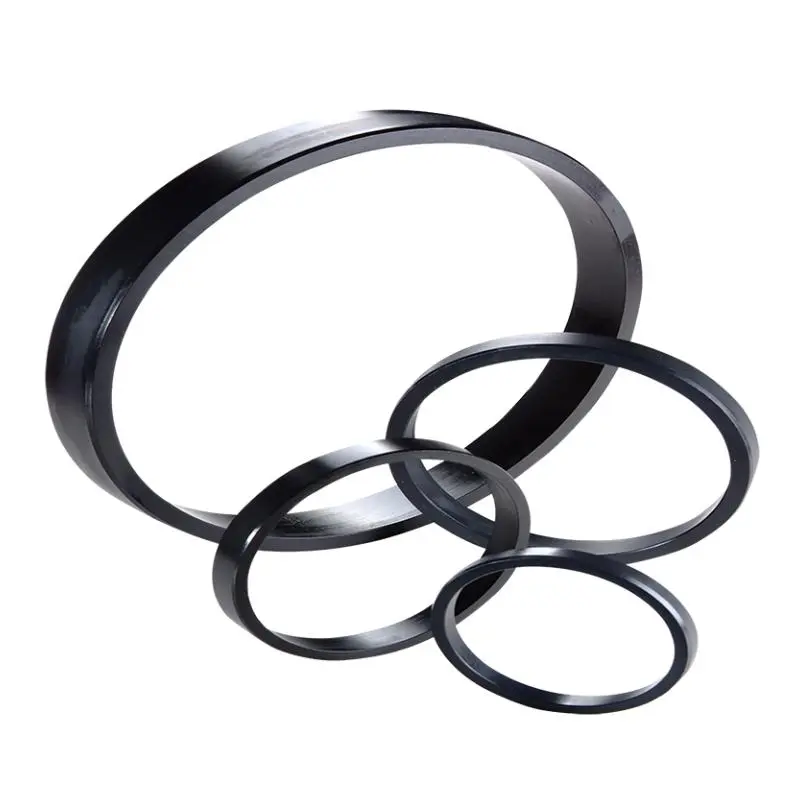
PEEK Seal Rings for Pumps
High-performance PEEK sealing solutions engineered for centrifugal pumps, water treatment, and food/pharma processing. Delivering exceptional wear resistance, high-temperature tolerance, and chemical stability to extend equipment service life and ensure reliable, contamination-free operation.
Performance & Technical Specifications
| Parameter | Value / Range | Test Standard / Notes |
|---|---|---|
| Operating Temperature | -40°C to +120°C (continuous, water media) -60°C to +200°C (short-term, non-aqueous) | GB/T 3512 hot water aging For pure PEEK only |
| Pressure Rating | ≤2.5 MPa (dynamic seal) ≤15 MPa (static seal) | GB/T 14211 mechanical seal test method With proper support ring design |
| PV Limit | ≤1.2 MPa·m/s (dry running) ≤2.5 MPa·m/s (water lubrication) | Pressure × velocity product Exceeding requires enhanced cooling |
| Friction Coefficient | 0.15–0.25 (water lubrication) 0.30–0.45 (dry state) | GB/T 3960, pure PEEK typical Add 10–15% PTFE to achieve 0.08–0.12 |
| Hardness | Shore D 85–88 (pure PEEK) Shore D 90–92 (30% glass fiber) | GB/T 2411 Higher rigidity, slightly brittle |
| Dimensional Tolerance | ID/OD: H8/h9 (±0.05–0.08 mm) Thickness: ±0.05 mm | Precision CNC machining Critical for seal face flatness |
| Surface Finish | Ra ≤ 0.8 μm (sealing face) Ra ≤ 1.6 μm (non-working surface) | GB/T 1031, lapped finish available to Ra 0.2 μm |
| Water Absorption | ≤0.15% (23°C / 24 h) ≤0.50% (100°C / 24 h) | ISO 62 / GB/T 1034 Minimal dimensional change |
| Tensile Strength | ≥95 MPa (23°C) ≥75 MPa (100°C) | GB/T 1040 / ISO 527 Retains strength at elevated temperature |
| Thermal Expansion | 4.7×10⁻⁵/K (pure PEEK) 3.0×10⁻⁵/K (30% glass fiber) | GB/T 1036 / ISO 11359 Better dimensional stability |
| Chemical Resistance | Excellent (water, weak acids/bases, salts, alcohols) | GB/T 11547 plastic chemical immersion test |
| Service Life | ≥8,000 hours (continuous, water lubrication, 1.0 MPa / 5 m/s) | Laboratory accelerated testing |
Need exact material specifications for your operating conditions?
Typical Applications
1. Centrifugal Pump Mechanical Seals
Secondary sealing elements (O-ring backup rings) for single/double mechanical seals. Prevents extrusion at up to 2.5 MPa and 120°C. Common in clean/hot water and condensate pumps.
2. Water Treatment & Desalination
High-pressure pump seal rings and balance drums for RO and EDI systems. Resistant to chloride ions and dosing (pH 6–9). Custom GF grades for seawater desalination (>8 MPa).
3. Food & Beverage Processing
Hygienic seal rings for homogenizers, juice pumps, and CIP systems. FDA 21 CFR 177.2415 and EU 10/2011 compliant. Withstands daily CIP cycles (80–95°C, 2% NaOH).
4. Pharmaceutical & WFI Systems
Seal rings for WFI preparation and aseptic filling. USP Class VI biocompatibility with ultra-low extractables (TOC < 0.5 ppm). Validated for 121°C SIP.
5. Residential & Commercial Pumps
Shaft seal rings and guide bushings for booster and submersible pumps. Direct replacement for rubber (no cracking) and SiC (no brittle fracture). 3–5× service life.
6. HVAC & Cooling Circulation
Wear-resistant seals for chilled water pumps and machine tool coolants. Tolerates frequent start-stop, particle abrasion (≤100 μm), and water quality fluctuations.
Discuss your specific application requirements with our engineering team.
PEEK vs. Alternative Seal Materials
| Property | PEEK | NBR Rubber | EPDM Rubber | PTFE | Silicon Carbide |
|---|---|---|---|---|---|
| Max Temp (Water) | 120°C | 90°C | 150°C | 260°C | 300°C+ |
| Pressure Rating | 2.5 MPa | 1.0 MPa | 1.0 MPa | 1.5 MPa | 10 MPa+ |
| Wear Resistance | ★★★★☆ | ★★☆☆☆ | ★★☆☆☆ | ★★★☆☆ | ★★★★★ |
| Impact/Toughness | ★★★★★ | ★★★★★ | ★★★★★ | ★★★★☆ | ★☆☆☆☆ (brittle) |
| Chemical Resistance | ★★★★☆ | ★★☆☆☆ | ★★★★☆ | ★★★★★ | ★★★★★ |
| Machining Cost | ★★★☆☆ | ★★★★★ | ★★★★★ | ★★★★☆ | ★☆☆☆☆ (expensive) |
| FDA Compliance | ✅ Yes | ⚠️ Limited | ⚠️ Limited | ✅ Yes | ✅ Yes |
| Best For | Balanced performance, food/pharma, moderate pressure | Low cost, low temp, oil resistance | Hot water/steam, low pressure | Ultra-low friction, extreme chemicals | Abrasive slurries, high pressure |
Selection Guide: Choose PEEK when you need better temperature/pressure than rubber, better toughness than ceramic, and FDA compliance — all in one material.
Not sure which material is right for your pump? Let us help you evaluate.
Common Failures & Troubleshooting
| Failure Mode | Root Cause | Solution |
|---|---|---|
| Leakage | Worn seal face, loose fit, over-temperature | 1. Check face flatness, relap to Ra ≤0.8 μm if needed. 2. Reduce radial clearance to 0.05–0.15 mm. 3. Switch to glass-fiber PEEK for >120°C. |
| Cracking/Fracture | Installation stress, dry running, insufficient toughness | 1. Use press-fit fixtures, avoid point loading. 2. Ensure water lubrication at startup (dry running >30s causes thermal shock). 3. Select impact-modified PEEK grade. |
| Rapid Wear | Abrasive particles, excessive PV, poor lubrication | 1. Install 50 μm pre-filter. 2. Verify PV ≤ 2.5 MPa·m/s. 3. Use carbon-fiber reinforced PEEK (30% better wear). |
| Thermal Deformation | Over-temperature, excessive interference fit | 1. Design 0.10–0.20 mm radial expansion gap per 50°C. 2. Control operating temp ≤110°C (pure) or ≤150°C (glass-filled). 3. Limit press-fit interference to 0.1–0.3% of diameter. |
| Hydrolysis/Aging | Long-term >140°C exposure, extreme pH | 1. Limit continuous exposure to ≤120°C. 2. For strong acids/bases, consider PTFE or PFA. 3. Regular CIP cleaning to prevent biofilm. |
Experiencing premature seal failure? Get expert troubleshooting support.
Procurement & Engineering Checklist
Required Technical Information:
- Media: Fluid type, temperature, pressure, pH, solids content
- Motion: Static / rotary / reciprocating; shaft diameter, RPM, linear velocity
- Dimensions: ID × OD × height (provide drawing), tolerance class, groove dimensions
- Mating Surface: Material, hardness (HRC), surface roughness (Ra)
Material Selection Guide:
| Grade | Composition | Best For | Limitations |
|---|---|---|---|
| Pure PEEK | 100% virgin PEEK | Food/pharma, high purity, best toughness | Max 120°C, moderate wear |
| 30% Glass Fiber | PEEK + 30% GF | High temp (to 150°C), high pressure, creep resistance | Slightly abrasive to soft shafts |
| Carbon Fiber + PTFE | PEEK + 15% CF + 10% PTFE | Low friction, dry-running risk, soft shaft compatibility | Not for food contact, black color |
Certification Requirements:
- Food contact: FDA 21 CFR 177.2415, EU 10/2011, GB 4806.1
- Pharmaceutical: USP Class VI, ISO 10993
- Drinking water: NSF/ANSI 61
Ready to move forward? Send us your drawing for a quick quote.
Frequently Asked Questions
Q1: What are the advantages of PEEK vs. rubber O-rings?
- Higher temperature: PEEK handles 120°C continuous hot water.
- Superior wear: PEEK wear rate < 10⁻⁷ mm³/Nm vs. rubber ~10⁻⁵ (5–10× longer life).
- Creep resistance: PEEK deformation < 1% under long-term load vs. rubber > 10% (maintains seal force).
- Chemical resistance: PEEK resists chlorine, ozone, UV; rubber cracks and swells.
- Lower friction: PEEK 0.15–0.25 vs. rubber 0.5–0.8.
Q2: Can PEEK replace silicon carbide ceramic seals?
Yes, in many cases. PEEK offers: 5× better impact resistance, 1/5 to 1/3 machining cost, and easier installation without brittle handling risk. (Choose ceramic when dealing with high abrasive slurries >100 ppm solids or extreme pressure >10 MPa).
Q3: How to choose between pure and modified PEEK?
- Pure PEEK: Food/pharma purified water (highest purity, best finish Ra ≤0.4 μm).
- 30% Glass Fiber: Hot water >100°C, high pressure (higher strength, creep resistance).
- CF + PTFE: Dry running risk, metering pumps (self-lubricating, lowest friction 0.08–0.12).
- Custom GF/CF: Seawater desalination HP pumps.
Q4: What causes dry running damage and how to prevent it?
Hazards: Localized temp spikes to 300°C+, friction coefficient jumps to 0.3–0.5, causing 100× accelerated wear.
Prevention: Install dry-run protection, prime pump/bleed air before startup, use self-lubricating PEEK grades, and design flush lines for continuous flow.
Q5: How to control assembly interference?
- Static (stationary ring): 0.1–0.2% of ID (e.g., 0.05–0.10 mm interference for Ø50 mm).
- Dynamic (rotating ring): 0.05–0.15 mm radial clearance.
- Assembly method: Liquid nitrogen shrink fit (-196°C) or heat housing to ≤80°C to prevent PEEK cracking.
- Note: PEEK expands ~0.24% per 50°C — reserve clearance accordingly.
Q6: Food-grade certification and maintenance?
Certifications: FDA 21 CFR 177.2415, EU 10/2011, GB 4806.1, NSF/ANSI 51.
Maintenance: Daily CIP (80–95°C, 2% NaOH or HNO₃). Avoid prolonged contact with >5% H₂O₂ or >200 ppm chlorine. Replace every 6–12 months or when wear >0.5 mm.
Q7: Seawater desalination applications?
Yes, PEEK resists chloride corrosion (≤35 g/L NaCl). For high-pressure RO pumps (>8 MPa), custom glass-fiber reinforced design is required. Pure PEEK is sufficient for 60–80°C preheated seawater. Ensure regular 0.5% NaClO disinfection.
Q8: When to replace PEEK seal rings?
- Leakage: >5 drops/minute or pressure drop >10%.
- Wear: Depth >0.5 mm or dimensional change >0.15 mm.
- Visual: Grooves, scratches, yellow-brown discoloration, burn marks.
- Hardness: Shore D decrease >5 points indicates aging.
- Schedule: Preventive replacement at 8,000 hours or 2 years.
Still have questions about PEEK seals?
About Dalian Allstar Material
Dalian Allstar Material Co., Ltd. is a national high-tech enterprise specializing in PEEK (polyetheretherketone) and PI (polyimide) polymerization, modification, and precision machining.
Core Capabilities:
- Complete PEEK resin synthesis and compounding
- 50+ CNC machining centers (±0.005 mm tolerance)
- ISO Class 7 cleanrooms for food/pharma production
- In-house tooling and rapid prototyping
- Quality Systems: ISO 9001, ISO 13485 (medical), FDA DMF registration
- Industries Served: Water treatment, food & beverage, pharmaceutical, semiconductor, oil & gas, and general industrial pumps.
Partner with an industry leader in PEEK precision manufacturing.
Contact Us / Request Quote
Please fill out the form below and our engineering team will get back to you shortly.