

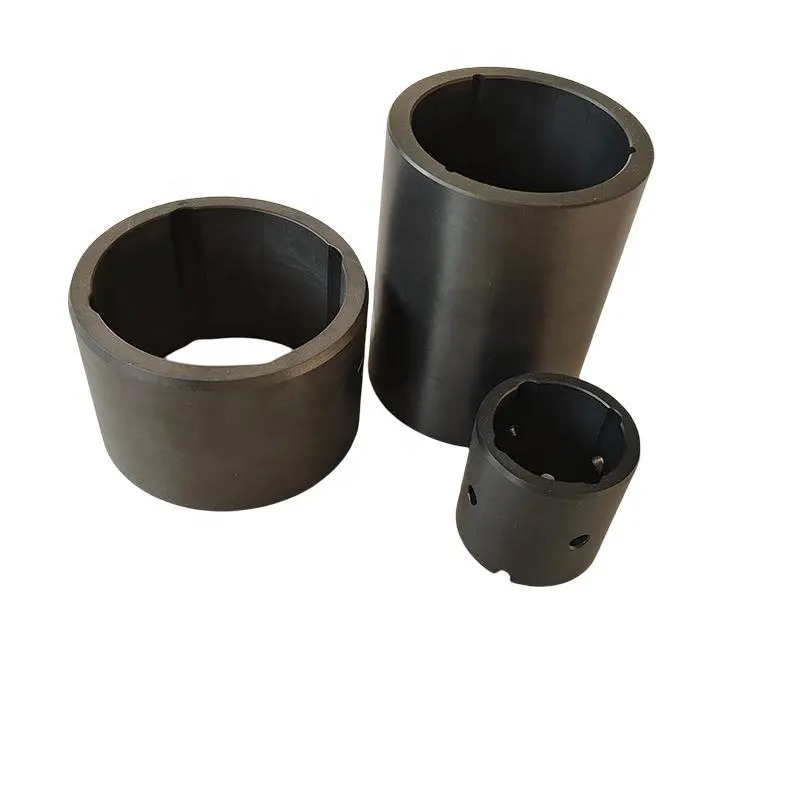
Performance Technical Parameters
- Working temperature range -60°C to +260°C (continuous), short-term peak +310°C
- PV value limits Dry running ≤ 1.8 MPa·m/s, water lubrication ≤ 2.5 MPa·m/s, oil lubrication ≤ 3.5 MPa·m/s
- Maximum load capacity Static ≤ 100MPa, dynamic ≤ 50MPa (pure PEEK), dynamic ≤ 75MPa (30% carbon fiber reinforced)
- Maximum linear speed ≤ 2.5m/s (dry running), ≤ 5m/s (lubricated conditions)
- Friction & Wear Friction coefficient: Dry state 0.12-0.18, water lubrication 0.08-0.12, oil lubrication 0.05-0.10. Wear rate: ≤ 5×10⁻⁸ mm³/N·m (against steel, dry state), ≤ 2×10⁻⁸ mm³/N·m (lubricated state)
- Surface roughness Inner bore Ra ≤ 0.4μm, outer diameter Ra ≤ 0.8μm
- Dimensional tolerances Inner diameter H7-H9 (+0.010 to +0.040mm), outer diameter h6-h8 (-0.010 to -0.035mm), length ±0.050mm
- Fit clearance Radial clearance 0.05-0.20mm (determined by shaft diameter and load)
- Hardness & Strength Shore D 85-92 (pure PEEK), Shore D 95-100 (carbon fiber reinforced). Compressive strength: ≥ 130MPa, flexural strength ≥ 170MPa
- Physical Properties Linear expansion coefficient: 4.7×10⁻⁵/K (pure PEEK), 3.0×10⁻⁵/K (30% CF reinforced). Water absorption rate: ≤ 0.5% (23°C, 24h immersion)
- Size specifications Inner diameter Φ5-Φ200mm, outer diameter Φ8-Φ250mm, length 5-300mm, wall thickness 1.5-25mm
Application Fields
Gear pumps and screw pumps
As pump shaft support bushings, bearing radial loads and axial thrust. When conveying corrosive chemicals, PEEK bushings resist strong acids and alkalis, avoiding bronze bushing corrosion failure. In high-temperature heat transfer oil pumps (temperature 180-220°C), maintains dimensional stability and low friction characteristics, inspection cycle exceeds 12,000 hours.
Hydraulic and pneumatic systems
Used for hydraulic cylinder piston rod guidance, cylinder buffers, control valve stem support. Withstands high-frequency reciprocating motion (cycle count > 106 times), wear amount only 1/5 of bronze. In oil-free lubrication pneumatic systems, self-lubricating properties ensure long-term maintenance-free operation.
Food and pharmaceutical equipment
Complies with FDA 21 CFR 177.2415 and EU 10/2011 food contact regulations, used in bearing positions of filling machines, mixers, and transfer pumps. Withstands CIP cleaning (80°C alkaline solution) and SIP sterilization (121°C steam), no metal ion precipitation, meeting GMP and HACCP requirements.
Semiconductor manufacturing
Applied in wafer transfer manipulators, chemical mechanical polishing equipment, vacuum pumps. Maintains chemical inertness in ultra-pure water, etching solutions, photoresists and other environments, particle precipitation < 1ppb, meeting Class 10 cleanliness standards. Resistant to plasma and ozone treatment.
Automotive industry
Used in electric power steering system worm gear bushings, transmission shift fork bushings, electric seat adjustment mechanisms. Maintains stable performance in -40°C to +150°C temperature cycling, reduces NVH (noise, vibration, harshness), lightweight design reduces weight by 30-50%.
Textile and printing machinery
Applied in high-speed roller bearings, yarn guides, tension control devices. Long-term operation at 2000-4000rpm speeds, resistant to dye and solvent corrosion, maintenance intervals extended to more than 3 times that of traditional bushings.
Common Failure Causes & Remedial Measures
Excessive wear
- Causes:
- ① Fit clearance too small (< 0.05mm) causing boundary lubrication failure;
- ② Shaft surface roughness too high (> Ra1.0μm);
- ③ PV value exceeding limit;
- ④ Foreign particles (hardness > HV 800);
- ⑤ Insufficient lubrication.
- Remedies:
- Increase radial clearance to 0.10-0.15mm;
- polish shaft surface to Ra0.4-0.8μm;
- recalculate PV value (< 80% of limit);
- install filtration device (≤ 25μm);
- select compatible greases (perfluoropolyether, polyalphaolefin).
Seizure or shaft binding
- Causes:
- ① Thermal expansion calculation error;
- ② Shaft bending or misalignment (> 0.10mm);
- ③ Assembly interference too large (> 0.05mm);
- ④ Lubrication film not established during cold start;
- ⑤ Burrs or scratches in bore.
- Remedies:
- Compensate clearance (increase 0.05-0.10mm per 100°C);
- check straightness (≤ 0.01mm/100mm); control press-fit interference (0.01-0.03mm) or adopt cold installation (-40°C to -78°C);
- preheat/run low speed to build film;
- remove burrs.
Cracking, breakage & Dimensional changes
- Cracking:
- Prevent impact loads exceeding material limits;
- avoid stress concentration (ensure fillets R ≥ 2mm);
- avoid sudden temp changes (> 100°C/min);
- ensure wall thickness ≥ 3-5mm.
- Dimensional changes:
- Caused by moisture absorption (≤ 0.5%), creep under load, or press-fit stress.
- Standard dry machining is sufficient;
- reduce stress to < 50% yield; select 30% CF PEEK for high temps;
- perform stress relief (150°C for 2 hours).
Procurement Selection Essential Parameters
When ordering, purchasing engineers must provide:
- ① Bushing installation location and working mode (rotating/reciprocating/oscillating).
- ② Bushing dimensions (ID × OD × length, e.g., Φ30×Φ40×50mm) and tolerance requirements.
- ③ Mating shaft diameter, surface hardness (required ≥ HRC 45) and roughness (recommended Ra0.6-0.8μm).
- ④ Working load (radial force, axial force), speed or reciprocating frequency.
- ⑤ Working environment (temperature range, media type, pH value, presence of lubrication).
- ⑥ Expected service life and maintenance cycle.
Selection conditions: Mating shaft surface requires hardening or nitriding treatment, hardness ≥ HRC 45 (recommended ≥ HRC 55), roughness Ra ≤ 0.8μm, roundness ≤ 0.015mm, cylindricity ≤ 0.020mm; bushing installation hole tolerance H7-H9 grade, surface clean without burrs; PV value must be within material capacity range (calculation formula: PV = P × V, P = radial load / projected area, V = πDN / 60000, D is shaft diameter in mm, N is speed in rpm).
For high-speed (> 1500rpm), heavy-load (> 20MPa) or high-temperature (> 150°C) conditions, detailed operating parameters and failure history must be provided. Our engineers will provide professional selection plans and CAD model confirmation within 24 hours, with sample testing verification if necessary.
FAQ (Frequently Asked Questions)
Q1: What advantages does PEEK bushing have compared to bronze bushing?
① Self-lubricating: friction coefficient 0.08-0.15, no need for external lubrication. ② Corrosion resistance: resistant to strong acids, alkalis and 200+ chemicals. ③ Wear resistance: wear rate only 1/5-1/3 of bronze, life extended 3-5 times. ④ Lightweight: density 1.3g/cm³, only 15% of bronze. ⑤ Low noise: reduces noise 5-15dB. ⑥ Maintenance-free: reduces costs 60-80%. ⑦ Food-grade: complies with FDA/EU regulations. ⑧ Insulation: prevents stray current corrosion.
Q2: How to determine bushing and shaft fit clearance?
Reference empirical formula: radial clearance = 0.001 × shaft diameter (mm) + correction amount. Correction factors: High speed (> 1500rpm) add 0.02-0.05mm; High temperature (> 100°C) add 0.05-0.10mm; Heavy load (> 30MPa) reduce 0.01-0.03mm; Reciprocating motion add 0.02-0.04mm; Dry running add 0.03-0.06mm. Too small causes friction heat accumulation, too large causes vibration and eccentric wear.
Q3: Can PEEK bushing work under non-lubricated conditions?
Yes, but with limitations based on PV value: Pure PEEK dry running PV ≤ 1.8 MPa·m/s. Adding solid lubricants can increase PV to 2.5 MPa·m/s; 30% CF + 15% PTFE composite can reach 3.0 MPa·m/s. Exceeding limits will cause friction heat > 260°C softening failure. For PV > 2.5 conditions, water or oil lubrication is recommended.
Q4: How to install PEEK bushing?
Three methods: ① Press-fit: interference 0.01-0.03mm, speed ≤ 3mm/s. ② Cold installation: cool in liquid nitrogen or dry ice alcohol (-78°C) for 5-10 mins, install within 1 minute. ③ Hot installation: heat housing to 150-200°C depending on interference requirement (PEEK withstands up to 260°C). Check concentricity ≤ 0.05mm after assembly.
Q5: How to choose between pure PEEK and reinforced PEEK bushing?
① Pure PEEK: best self-lubricating, suitable for low speed (< 1000rpm), light load (< 20MPa). ② 30% Carbon Fiber: load capacity +50%, suitable for high speed (1000-3000rpm) and heavy load (20-50MPa). ③ 15% PTFE + CF Composite: PV value up to 3.0 MPa·m/s, best wear resistance. ④ 10-15% Glass Fiber: moderate cost, highest cost-performance ratio for general conditions.
Q6: What is the service life of PEEK bushing?
Wear limit is usually 20-30% of wall thickness. Typical life: Clean water gear pump (PV=1.5): 25,000-40,000 hours; Hydraulic cylinder reciprocating (PV=2.0): 10,000-15,000 hours; Dry running pneumatic (PV=1.0): 5,000-8,000 hours. Replace when wear exceeds 0.5mm or vibration increases > 30%.
Q7: Can PEEK bushing withstand impact loads?
Pure PEEK impact strength is 85 kJ/m², suitable for light impact (clutch, cylinder buffer). CF reinforced PEEK brittleness increases (50-60 kJ/m²). For heavy impacts, increase wall thickness 2-3 times, add elastic buffer elements, or use composite metal/PEEK bushings.
Q8: What should be noted when PEEK bushing mates with stainless steel shaft?
Shaft requires hardening to HRC 50-60 or nitriding/PVD coating to HRC 60-70 to avoid being reverse-worn by PEEK. Surface roughness Ra 0.4-0.8μm is optimal. Note that PEEK expansion coefficient is 2.8 times that of stainless steel, requiring clearance compensation at high temperatures.
About Dalian Allstar Material
Dalian Allstar Material is a professional enterprise focusing on PEEK and PI high-performance polymer research, development and manufacturing. The company has a complete material modification, precision machining and quality inspection system, equipped with Swiss imported CNC machining centers, coordinate measuring machines and friction wear testing equipment. Professionally provides customized solutions for various bushings, sleeves and sliding bearings, with products widely applied in pumps and valves, hydraulic and pneumatic, food and pharmaceuticals, semiconductors, automotive and other fields, helping customers reduce maintenance costs and improve equipment reliability.
Request a Quote
Please fill out the form below. Our technical team will respond within 24 hours.