

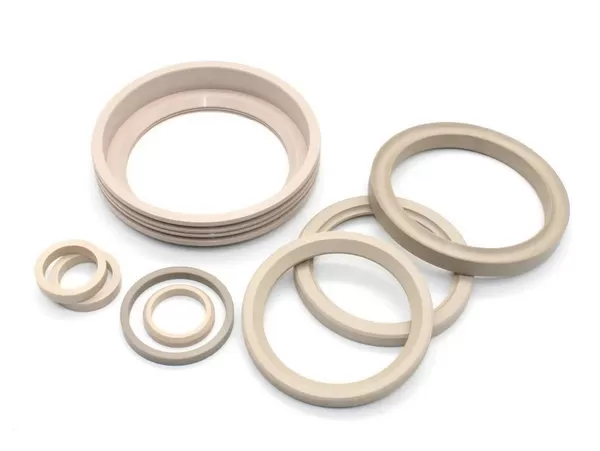
Performance and Technical Parameters
| Performance Indicator | Value / Range | Description |
|---|---|---|
| Operating Temperature Range | -60 °C to +250 °C (continuous); +300 °C (short-term) | Retains mechanical strength across a wider working range than PTFE, ideal for hot oil, steam and superheated media |
| Pressure Load Capacity | ≤ 175 MPa (long-term); ≤ 200 MPa (peak) | When paired with a primary seal, raises the pressure ceiling of standard O-rings from ~10 MPa to over 50 MPa |
| Hardness | Shore D 88–92 | Provides rigidity to bridge extrusion gaps while retaining installability |
| Anti-Extrusion Gap | ≤ 0.20 mm @ 20 MPa ≤ 0.15 mm @ 50 MPa ≤ 0.10 mm @ 100 MPa |
Optimized to prevent O-ring cold-flow into clearance gaps |
| Radial Wall Thickness | 0.8–3.0 mm | Customized to groove geometry; standard configurations 1.5–2.0 mm |
| Cross-Section Tolerance | ± 0.05 mm | Ensures precision fit and repeatable assembly |
| Surface Roughness | Ra ≤ 0.8 μm (sealing face) Ra ≤ 1.6 μm (non-working face) |
Reduces friction and prolongs service life |
| Friction Coefficient | 0.10–0.15 (dry) 0.05–0.08 (lubricated) |
Inherent self-lubrication reduces breakaway and running resistance |
| Chemical Resistance | Strong acids, strong alkalis, organic solvents, H₂S, CO₂ | Limited only by concentrated H₂SO₄ and HNO₃ at elevated temperatures |
| Anti-Creep (Cold Flow) | ≥ 5 × better than PTFE | Creep rate < 0.5 % vs. PTFE 3–5 %; dimensionally stable under sustained load |
| Key Mechanical Properties | Tensile ≥ 100 MPa Flexural ≥ 165 MPa Tg = 143 °C |
Retains > 80 % tensile strength at 200 °C |
Typical Application Fields
Oil & Gas Exploration and Transportation
Downhole packers, wellhead assemblies, high-pressure manifolds — preventing O-ring extrusion failure under formation pressures ≥ 50 MPa, and resisting sour-service environments containing H₂S / CO₂.
Hydraulic and Pneumatic Systems
Piston and rod seals in heavy-duty hydraulic cylinders (≥ 25 MPa) for construction equipment, injection molding machines, and hydraulic presses; aerospace hydraulic circuits (≥ 35 MPa, -54 °C to +200 °C).
Chemical Pumps and Valves
Shaft seals and mechanical seal support in multistage centrifugal pumps and plunger pumps; anti-extrusion protection for ball valve and gate valve seats handling caustic and chlor-alkali media.
Semiconductor & Pharmaceutical
Ultra-pure media transfer systems (electronic-grade chemicals, WFI); FDA-compliant and USP Class VI grades available with no leachable contamination.
Automotive and Aerospace
Common-rail fuel injection pumps (≥ 200 MPa), transmission hydraulics; aircraft engine fuel and hydraulic sealing under extreme thermal cycling and vibration.
Have a Specific Application in Mind?
Share your operating conditions and requirements with us. Connect with our application engineers for a custom-engineered PEEK sealing solution.
Contact Our Engineers
Please fill out the form below, and we will get back to you within 24 hours.
Common Failure Modes and Remedies
Primary Seal Extrusion or Nibbling
CAUSES
- Insufficient wall thickness
- Excessive extrusion gap
- System over-pressure
REMEDIES
- Increase ring cross-section by 0.3–0.5 mm
- Reduce extrusion gap to ≤ 0.15 mm
- Switch to twin-ring configuration for > 70 MPa
Backup Ring Cracking or Fracture
CAUSES
- Excessive installation stress
- Brittle material grade selection
- Severe thermal shock
REMEDIES
- Use chamfered installation tooling
- Select toughened / GF-reinforced PEEK
- Preheat ring to 60–80 °C before assembly
Persistent Leakage
CAUSES
- Dimensional deviation (out of tolerance)
- Damaged primary seal (O-ring)
- Rough hardware groove
REMEDIES
- Verify inner Ø H9 / outer Ø h8 tolerances
- Replace O-ring simultaneously
- Regrind groove to Ra ≤ 0.8 μm
Installation Difficulty or Jamming
CAUSES
- Excessive hardness of the ring
- Oversized cross-section
- Low ambient temperature during assembly
REMEDIES
- Use dedicated expansion tooling
- Apply silicone or media-compatible lubricant
- Warm to room temperature when ambient < 10 °C
Media Incompatibility
CAUSES
- Media outside compatibility envelope
- Maximum operating temperature exceeded
REMEDIES
- Cross-check PEEK chemical compatibility chart
- Upgrade to PI or modified PEEK for > 250 °C
- Use PTFE or metal for > 90% H₂SO₄
Essential Information for Procurement Engineers
Technical Data Needed for Quotation
- System Parameters: Maximum / normal operating pressure (MPa), temperature range (°C), media type & concentration, static vs. dynamic sealing.
- Seal Groove Dimensions: Inner diameter $D_1$, outer diameter $D_2$, groove depth $H$, extrusion clearance $\delta$ (mm; engineering drawing preferred).
- Primary Seal Specification: O-ring standard (GB, JIS, AS568…), cross-section diameter, elastomer material (NBR / FKM / FFKM).
- Service Characteristics: Stroke frequency & speed (dynamic), pressure pulsation, media viscosity, solid-particle content.
Selection Guidelines
- Ring Cross-Section: Recommended clearance $\delta \le 0.02 \cdot P + 0.03$ (where $P$ = MPa); single or twin-ring configuration.
- Material Grade: Pure PEEK (≤ 25 MPa); 30% glass-fiber PEEK (25–70 MPa); 30% carbon-fiber PEEK (> 70 MPa or wear-intensive service).
- Tolerance Grade: Precision grooves H7/h6; standard grooves H9/h8; ring cross-section ± 0.05 mm.
- Surface Treatment: Optional low-friction coating or edge chamfering for easier installation.
Have Your Technical Data Ready?
Submit your system parameters, groove dimensions, or engineering drawings directly to our sales engineers for a rapid quotation and technical feasibility review.
Submit Your Specifications
Please provide your operating conditions or attach a drawing. Our sales engineers will respond within 24 hours.
Frequently Asked Questions (FAQ)
Q1: What advantages do PEEK backup rings offer over PTFE backup rings?
- Stronger anti-extrusion: Shore D 88 (PEEK) vs. Shore D 50–65 (PTFE), resulting in far less deformation under high pressure.
- Excellent cold-flow resistance: PEEK creep rate < 0.5% vs. PTFE 3–5%, remaining dimensionally stable under sustained load.
- Superior high-temperature strength: PEEK retains > 80% tensile strength at 200 °C, whereas PTFE loses significant strength above 150 °C.
- Broader chemical resistance: PEEK safely handles strong alkalis (e.g., 50% NaOH) and amines that typically degrade certain PTFE compounds.
Q2: How do I size a PEEK backup ring cross-section?
The radial wall thickness $h$ should be at least 1.5–2 × the extrusion gap $\delta$, and no more than 70% of groove depth to avoid over-preloading.
The axial width $t$ should be 0.4–0.8 × the O-ring cross-section diameter $w$ ($0.6w$ is recommended).
Example: For an O-ring Ø 3.55 mm (JIS P5), with $\delta = 0.15$ mm operating at 40 MPa, the recommended values are $h \approx 0.8$ mm (minimum standard) and $t \approx 2.1$ mm.
Q3: When should I choose single vs. twin backup rings?
- Single ring: Recommended for ≤ 50 MPa, unidirectional pressure, or cost-sensitive applications.
- Twin rings: Required for > 50 MPa, bidirectional pressure (reciprocating service), or extreme conditions (particulate media). Note: Twin-ring grooves require additional width plus 0.3–0.5 mm inter-ring clearance to prevent jamming.
Q4: Is there an installation orientation requirement?
For split rings (spiral cut), the opening should face away from the pressure source, offset by 30–45°, to prevent high-pressure media from directly attacking the split. Solid closed rings have no orientation requirement but require an expansion mandrel and sizing tool for installation.
Q5: When should a PEEK backup ring be replaced?
A replacement is necessary if you observe any of the following:
- The primary seal shows repeat leakage or extrusion damage.
- Cracks, chips, or visible plastic deformation appear on the ring.
- The ring-to-groove fit has become noticeably loose (hand-removable).
- System pressure has been up-rated > 20% above the original design.
Best Practice: Replace concurrently with the primary seal. Preventive replacement interval is typically 1.5–2 × the primary seal’s service life.
Q6: Can PEEK backup rings be used with particulate media?
They are suitable for light abrasive service (particle size < 50 μm, content < 5%); 30% carbon-fiber reinforced PEEK is recommended here for improved wear resistance. For heavy abrasive service (e.g., mud pumps, heavy slurry pumps), metallic or ceramic-coated backup rings are advised, as PEEK is susceptible to scoring by large, hard particulates.
Q7: How do PEEK backup rings perform at low temperatures (e.g., -40 °C)?
PEEK maintains excellent toughness and dimensional stability down to -60 °C. (For deep-cryogenic service < -100 °C, PTFE remains the material of choice). Low-temperature best practices include:
- Warm the rings to room temperature before installation to prevent brittle fracture.
- Expect a 15–25% increase in dynamic breakaway friction; allow adequate torque margin.
- Use low-temperature-rated lubricants (e.g., PFPE) to reduce cold-start wear.
Q8: How can I verify PEEK backup ring quality?
Always request the following documentation from your supplier:
- Material Certificate: Check for density 1.30 ± 0.02 g/cm³, melting point 343 ± 3 °C, hardness Shore D 88–92.
- Dimensional Inspection Report: Verify standard tolerances (e.g., ± 0.05 mm) and surface finish (Ra ≤ 0.8 μm).
- Pressure Test Data: Ensure no leakage after a 72-hour hold at rated pressure and temperature.
- DSC Thermal Analysis: For critical applications, request a DSC curve to confirm authentic PEEK resin is used, rather than PPS or lower-cost substitutes.
About Dalian Allstar Material
Dalian Allstar Material is a Chinese national high-tech enterprise dedicated to the R&D, manufacturing, and technical service of high-performance engineering polymers, including PEEK (polyetheretherketone) and PI (polyimide).
With in-house polymerization and compounding capability, precision CNC machining centers (± 0.03 mm), and a full performance-testing laboratory, we deliver end-to-end solutions from material selection and structural design to serial production. Our products serve 500+ customers across petrochemical, aerospace, semiconductor, and medical device industries, with exports to 30+ countries including Europe, North America, the Middle East, and Southeast Asia.
Core Advantages
- ✓ Proprietary PEEK polymerization and modification — customizable reinforced / lubricated grades
- ✓ Precision machining to ± 0.03 mm — qualified for high-end equipment OEMs
- ✓ Full traceability — ISO 9001 & API Q1 certified quality system
Get in Touch
Fill out the form below and our material experts will reach out to you shortly.