
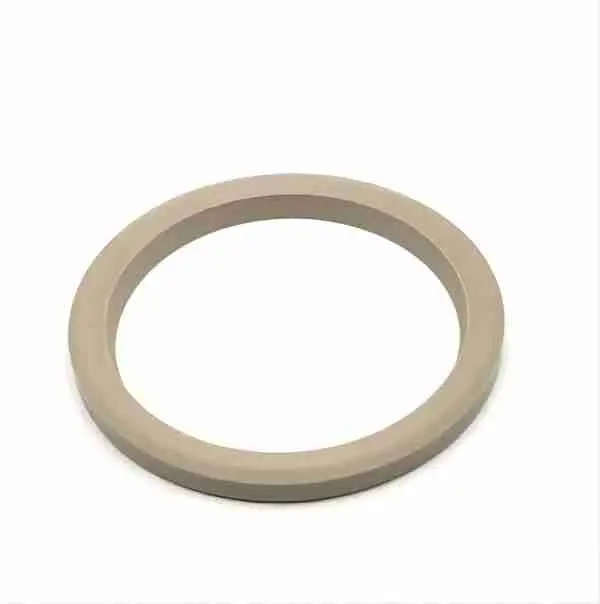
PEEK Insulating Ring for Logging Tools
High-performance electrical insulation component engineered for oil & gas downhole equipment, providing electrical isolation and mechanical support for critical parts such as downhole electronics, electrical connectors, and sensors. Manufactured from Dalian Allstar Material’s in-house high-purity PEEK via precision CNC machining. It is the proven, tougher, and more cost-effective alternative to brittle ceramic and glass-to-metal insulation.
Performance and Technical Parameters
| Performance Indicator | Value/Range | Test Standard / Description |
|---|---|---|
| Operating Temperature | -60 °C to +200 °C (continuous); +250 °C (short-term, ≤2 h) | Continuous rating per UL 746B RTI; suitable for API-class downhole tools |
| Pressure Load Capacity | ≤120 MPa (long-term); ≤150 MPa (short-term peak) | Long-term hydrostatic testing per ISO 1167-1; suitable for deep wells (≥6,000 m) |
| Volume Resistivity | ≥1.0×10¹⁶ Ω·cm (23 °C/50% RH); ≥5.0×10¹⁵ Ω·cm (150 °C) | GB/T 31838; two orders of magnitude above typical downhole insulation requirements |
| Surface Resistivity | ≥1.0×10¹⁵ Ω/sq (23 °C); ≥1.0×10¹⁴ Ω/sq (150 °C, humid) | GB/T 31838; stable insulation in humid well conditions |
| Dielectric Strength | ≥25 kV/mm (2 mm thickness); ≥20 kV/mm (5 mm) | GB/T 1408.1, short-time power-frequency test (50 Hz, 1 min) |
| Dielectric Constant & Dissipation | 3.2–3.3 (23 °C); tan δ ≤0.003 (1 MHz) | GB/T 1409; low dielectric loss preserves signal quality |
| Dimensional Tolerance | ID/OD: H8/h9 (±0.05–0.08 mm); thickness: ±0.05 mm | Precision machining to meet logging tool assembly accuracy |
| Water Absorption | ≤0.10% (23 °C/24 h); ≤0.50% (23 °C, saturated) | GB/T 1034; dimensional and dielectric stability in wet wells |
| Compressive Strength | ≥120 MPa (axial); ≥90 MPa (radial) | GB/T 1041; withstands downhole mechanical stress |
| Chemical Resistance | Excellent (H₂S, CO₂, hydrocarbons, brine) | Aged per ISO 23936-1 / NORSOK M-710; <1% mass change after 168h |
Ensure peak performance in extreme HPHT conditions. Get our full material data sheet.
Applications
1. Logging While Drilling (LWD/MWD) Tools
Insulation isolation for electrical connectors in directional gamma, resistivity, and porosity sensor modules; high-voltage insulation for downhole generators and battery packs, at up to 175 °C with vibration acceleration ≥30 g.
2. Wireline Logging Instruments
Electrode insulating rings for natural gamma, acoustic, and imaging probes; high-voltage excitation circuit isolation in multipole array acoustic tools (≥1,000 V), ensuring interference-free weak-signal transmission.
3. Production Logging & Monitoring
Cable feed-through insulation for permanent gauges (pressure, temperature, flow); insulating sleeves for ESP motor lead wires (≥150 °C, oil resistant).
4. HPHT Electrical Connectors
Insulators and positioning rings for downhole connectors (≤240 °C/150 MPa); a toughened replacement for brittle glass-to-metal seals — cutting cost by 30–50%.
5. Geothermal & CO₂ Storage Monitoring
Insulation support for geothermal well instruments; sour-service insulating rings for CO₂ injection well probes (supercritical CO₂ immersion ≥1,000 h).
Discover how our PEEK rings can be tailored to your specific logging instruments.
Common Failure Modes and Remedies
| Failure Phenomenon | Possible Causes | Remedial Measures |
|---|---|---|
| Insulation resistance drop / leakage | Conductive surface contamination (mud, salts), over-temperature, moisture uptake | 1. Ultrasonic cleaning + ethanol wipe; 2. Drying at 150 °C/3 h; 3. Switch to PEK/PEKK or 30% GF PEEK for >200 °C; 4. Apply hydrophobic coating. |
| Breakdown or arcing | Insufficient wall thickness, internal voids, excessive voltage gradient | 1. Wall thickness ≥2 mm; 2. Use compression-molded, void-free PEEK blanks; 3. Chamfer sharp edges (R≥0.5 mm). |
| High-temperature dimensional deformation | Thermal expansion mismatch, assembly stress, over-temperature use | 1. Design 0.15–0.25 mm radial clearance per 100 °C; 2. Use 30% glass-filled PEEK; 3. Select PEK/PEKK for continuous >200 °C. |
| Mechanical fracture or cracking | Impact loading, stress concentration, insufficient toughness | 1. Rounded transitions (R≥1 mm); 2. Toughened PEEK grade (impact strength ≥10 kJ/m²); 3. Reserve 0.05–0.10 mm assembly clearance. |
| Pressure resistance degradation | Long-term creep, thermal cycling, chemical attack | 1. High-crystallinity PEEK (≥35%); 2. Inspection every ≤500 h; 3. Cross-linked/modified PEEK for aggressive media. |
Experiencing premature insulation failure? Let our experts help you troubleshoot.
Information for Procurement Engineers
Required Technical Information:
- Electrical parameters: operating voltage (DC/AC, V), leakage current limit (μA), insulation resistance requirement (Ω), dielectric strength (kV/mm), signal frequency range (Hz–MHz)
- Operating environment: well depth (m), bottom-hole temperature (°C), pressure (MPa), media (freshwater/brine/oil-based mud/sour gas), expected service life (h)
- Dimensions: ID × OD × height (mm; assembly drawing or 3D model preferred), mating tolerance (H7/H8/H9), special features (grooves/steps/threaded holes)
- Mechanical requirements: axial load (N), impact strength (J), surface roughness (Ra)
Key Selection Criteria:
- Material grade: pure PEEK (≤175 °C/low load), 30% glass-filled PEEK (≤200 °C/high load), PEK/PEKK (>200 °C continuous)
- Compliance: API Q1 quality system, ISO 23936 / NORSOK M-710 material qualification, ATEX, RoHS/REACH as required
- Processing method: CNC turning (small batch/complex geometry), injection molding (high volume), compression molding + machining (high purity/void-free)
Streamline your supply chain with proven, API-compliant components.
Frequently Asked Questions
Q1: What are the advantages of PEEK insulating rings vs. ceramic and glass insulation?
A: ① Impact toughness: PEEK survives downhole vibration without fracture; ② Machinability: CNC-machinable into threads and grooves; ③ Lower density: reducing tool string weight; ④ Thermal shock resistance: withstands rapid -60 °C to +200 °C cycling; ⑤ Cost: 30–50% lower total cost than glass-to-metal seals.
Q2: Pure PEEK or glass-fiber reinforced PEEK?
A: Pure PEEK for best dielectric performance and smooth finish (for >1,000 V circuits). 30% glass-filled PEEK for +40% mechanical strength, high axial loads, and ≥175 °C environments. Rule of thumb: electrical performance first → pure PEEK; mechanical performance first → glass-filled.
Q3: How do the rings hold up in hot, humid wells?
A: PEEK absorbs only 0.5% water, with <10% insulation resistance loss when wet. For best results, dry at 150 °C/3 h before assembly and ensure proper O-ring/lip-seal enclosure.
Q4: Can PEEK rings withstand H₂S/CO₂ sour environments?
A: Yes. Aged per ISO 23936 / NORSOK M-710 in simulated sour conditions (150 °C/20 MPa, saturated H₂S+CO₂) for 1,000 h: mass change <0.5%, insulation resistance loss <15%, mechanical retention ≥90%.
Q5: Low-temperature performance (e.g., deep-sea logging at -20 °C)?
A: PEEK retains toughness and dielectric strength down to -60 °C. Insulation resistance rises at low temperatures, and strength increases 10–15%.
Have specific technical or material compliance questions?
About Dalian Allstar Material
Dalian Allstar Material is a national high-tech enterprise specializing in the R&D, production, and technical service of specialty engineering plastics including PEEK and PI. With in-house PEEK polymerization and compounding platforms, precision CNC machining centers, and an electrical testing laboratory, we deliver customized high-performance insulation solutions for oil & gas, aerospace, power electronics, and semiconductor industries.
Core Capabilities:
- In-house PEEK formulation: pure, glass/carbon-fiber reinforced, ESD/conductive, and ultra-high-temperature PEK/PI composite series
- Precision machining: tolerances ±0.03–0.05 mm, Ra ≤0.4 μm, complex features (threads, grooves, steps)
- 100% electrical inspection: megohmmeter, hipot, and permittivity testing on every shipped part
- Quality systems: ISO 9001 and API Q1 certified; materials qualified per ISO 23936 / NORSOK M-710
- Fast delivery: standard parts 3–5 days, custom parts 7–15 days, 24-hour expedited service for urgent orders
Partner with an industry leader in downhole insulation manufacturing.
×
Contact Us / Request Quote
Please fill out the form below and our engineering team will get back to you shortly.